euractiv.de
 euractiv.fr
 euractiv.es
 euractiv.it
 euractiv.pl
 euractiv.cz
 euractiv.gr
 euractiv.ro
 euractiv.sk


Produced with financial support from an organization or individual, yet not approved by the underwriter before or after publication.
This article is part of our special report EUYou – Europe is you.
Hungary is navigating a critical phase in its relationship with the European Union. Billions in cohesion funds are at stake, and without meaningful reform, Budapest risks long-term economic consequences.
Hungary was originally set to receive €21.7 billion from the EU for the 2021-2027 period, based on decisions made in December 2022. However, it lost €1.04 billion because some funds were suspended in 2022.
Statistic One
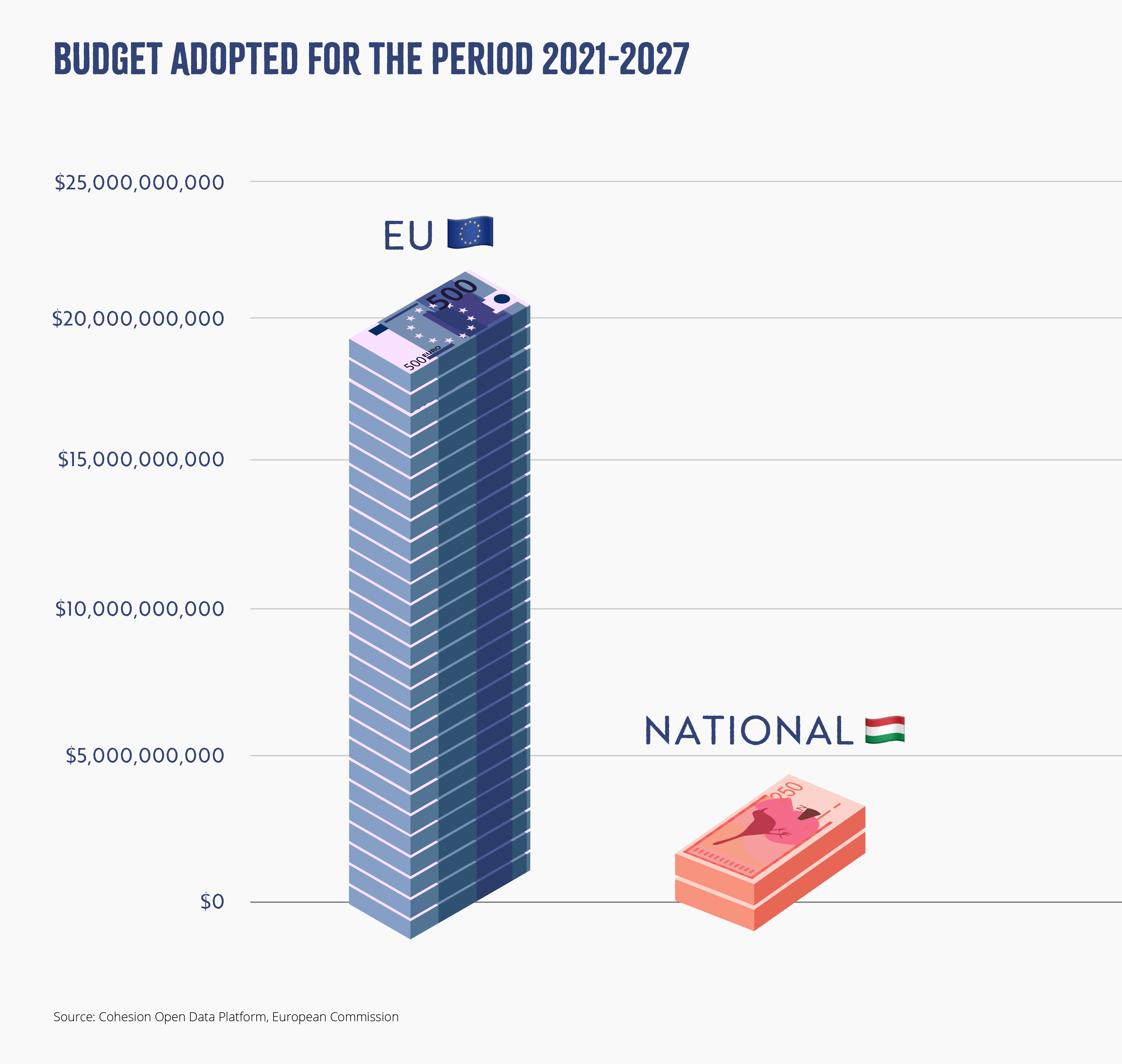
These funds are allocated under the “investment in jobs and growth” objective, supported by the European Regional Development Fund (ERDF), European Social Fund Plus (ESF+), Cohesion Fund (CF), and Just Transition Fund (JTF).
Statistic Two

Supporting businesses
EU cohesion policy funds are helping Hungarian businesses become more productive and competitive by improving the overall business environment.
The ERDF is investing in 6,600 small and medium-sized enterprises (SMEs), encouraging €560 million in private investment. These grants are part of larger investment-loan programmes launched in 2024.
The ERDF also supports innovation for up to 2,500 SMEs, including improvements in how they organise and run their operations. Additional programmes focus on helping SMEs with digital upgrades, especially in advanced technologies.
The ESF+ contributes around €1 billion to improve job opportunities, especially for young people and those most in need. It supports training, wage subsidies, workplace safety and health checks, with a special focus on green and digital skills.
Efforts also aim to improve vocational education by reducing school dropouts, updating teaching methods, and prompting apprenticeships through new training centres.
Statistic Three

Governance structure
In recent years, Hungary has made changes to make its development and humanitarian work more coordinated.
The Ministry of Foreign Affairs and Trade (MFAT) is now in charge of planning and managing this work. The Hungary Helps Agency carries out most of the actual projects.
Two financial institutions handle special aid-tied loans, and the Tempus Foundation runs the country’s scholarship programme for foreign students. Other ministries also help with development efforts by providing funding or support.
About 150 people at MFAT and other agencies work on these programmes, and economic diplomats at Hungarian embassies manage relationships with partner countries.
While there is no formal system for involving outside groups in decision-making, Hungary did consult them when shaping its development strategy. Civil society organisations focused on aid and education coordinate through a national NGO umbrella network.
Statistic Four

Billions of euros at stake
However, the country is at serious risk of losing a large portion of its EU funds due to a lack of progress on key reforms.
Between 2019 and 2024, Hungary fully implemented only 2 per cent of the country-specific recommendations and made significant progress on another 2 per cent. The remaining 96 per cent show either limited or no progress at all.
This poor performance puts both the 2021-2027 EU funding period and Hungary’s access to the Recovery and Resilience Facility (RRF) in jeopardy – especially since the country has not yet met any of the required milestones to unlock RRF funds.
In response, the Hungarian government has proposed new regulations to manage EU funding more flexibly, allowing the government to selectively delay or cancel certain projects.
Despite already launching numerous calls for proposals under the 2021-2027 funding period and disbursing billions of forints, much of the funding comes from Hungary’s own budget as pre-financing, not from actual EU disbursements.
European Commission data show that from the current cycle, Hungary has received only a small fraction of the available funds.
Statistic Five

No progress, no money
A similar situation exists for cohesion funds, with some projects – especially in more developed regions like Budapest – at risk of being officially labelled as unviable and excluded from funding. This could affect public and municipal investments if they rely on blocked EU money.
Meanwhile, Hungary is also losing money due to penalties from the European Court of Justice.
Because it has not implemented required reforms to its asylum system, the country is being fined €1 million per day, plus a one-time €200 million penalty, both deducted from its EU funding. These fines have already cost the Hungarian budget around €600 million.
Unless Hungary shows real progress on reforms, particularly in areas such as judicial independence, anti-corruption measures and public procurement, it risks losing even more EU funding.
That is why the next 18 months are critical: failure to act could reshape how EU money is distributed in Hungary, likely shifting it away from state-led projects and the country’s more developed regions.
[Edited By Brian Maguire | Euractiv's Advocacy Lab ]
Updated: 30-06-2025