euractiv.de
 euractiv.fr
 euractiv.es
 euractiv.it
 euractiv.pl
 euractiv.cz
 euractiv.gr
 euractiv.ro
 euractiv.sk

Produced with financial support from an organization or individual, yet not approved by the underwriter before or after publication.
This article is part of our special report The EU’s Fusion Strategy – Can Europe lead the clean energy race?.
Nuclear fusion has been described as the holy grail of energy, offering the possibility of CO2-free power generation that does not rely on imports. But despite decades of research and development, there has still not been a breakthrough that would make the technology competitive with nuclear fission, the process used in today’s nuclear plants.
The Barcelona-based organisation Fusion for Energy (F4E), a joint undertaking of Euratom and the EU created in 2007, has been coordinating Europe’s contribution to the France-based International Thermonuclear Experimental Reactor (ITER).
F4E recently held a conference with politicians and stakeholders in Barcelona to evaluate what it will take for Europe to continue its early lead on fusion technology, especially as China and the United States are now receiving most of the research funding.
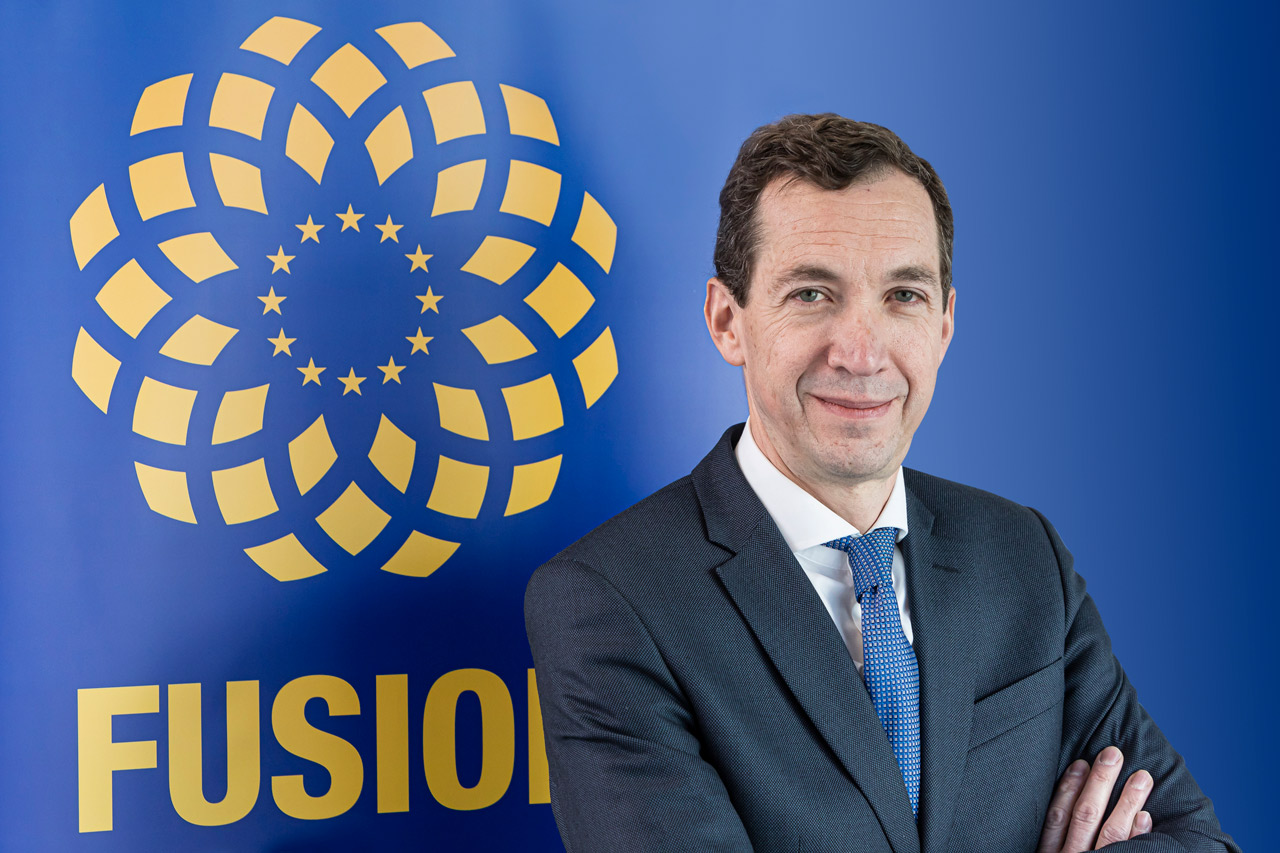
Euractiv asked F4E Director Marc Lachaise what is needed for a renewed focus on fusion in Europe.
EV: What is nuclear fusion, and how does it differ from the nuclear fission that has been used to generate electricity over the past decades?
ML: Fusion is the process that powers the sun and other stars. It holds the key to safe, virtually unlimited and clean energy, offering Europe greater autonomy, security and resilience.
It comes with far-reaching benefits. For example, the fuels required are abundant enough to last millions of years, reducing our dependence on fuels, which often generate geopolitical tensions. Small amounts of fuel can generate plenty of energy: 60 kg of fusion fuel can provide the same amount of energy as 250,000 tonnes of oil.
There are no greenhouse gas emissions or long-lasting radioactive waste produced, and fusion power plants would be inherently safe with no risk of chain reactions, posing very low risks to populations in the vicinity. Steady and reliable energy will be generated, complementing renewables in providing a ‘baseload’ electricity.
Fusion for Energy plays a key role in shaping Europe’s capacity to deliver on this technology. We partner with European industry to provide components and expertise to ITER, the biggest international fusion experiment, plus projects such as JT-60SA in Japan, or DONES in Spain.
We develop the talent and knowledge for the construction and operation of commercial fusion power plants in Europe, and we create and consolidate an EU supply chain.
EV: Europe has been an early leader in fusion because of the ITER project. Where does the progress for ITER stand right now? What lessons have been learned so far?
ML: Europe has been a leader in hosting important fusion facilities before ITER. For example, ASDEX and W7-X in Germany, WEST in France, DTT in Italy, and JET. Thanks to our commitment, we have created a large community of experts who have been successfully breaking records and advancing fusion science.
ITER, however, raised the stakes like no other project – it’s the biggest fusion project of its type ever constructed and aims to produce ten times more heat than required to start the fusion reactions.
By bringing together half of the world’s population, representing 80% of the global GDP through the participation of China, Europe, Japan, India, South Korea, Russia and the United States, it highlighted the importance of international science diplomacy and collaboration.
Europe, as host of the project and responsible for nearly half of it, has the highest level of involvement. F4E offers companies unparalleled opportunities to learn by manufacturing. One of the clear lessons is that supply chains matter, together with the level of investment and continuity. We need to engage with industry as equal partners and make them part of the long-term strategy. F4E has been a catalyst in putting together the biggest supply chain in fusion, which is a vital element of the ecosystem.
In terms of progress, an optimised ITER project plan has been developed, reinforcing our commitment. Europe has completed most of the buildings, all its magnets, two sectors of the vacuum vessel, and other pieces of equipment.
These massive components are now being assembled to form the core of the machine. Thanks to ITER, we will test many technologies in an integrated manner and study a burning plasma that will release more energy than that used to produce it.
EV: Do you think Russia's invasion of Ukraine has changed Europe's thinking about energy independence? How can nuclear fusion help Europe meet its climate goals?
ML: Undoubtedly, the consequences on the international level have been severe. There is a before and after this incident, forcing Europe to reconsider its power supply and energy mix. The European Commission responded quickly with REPowerEU, seeking alternatives to ensure a steady supply of fuels to protect businesses and citizens.
Europe’s energy autonomy is of strategic importance. Otherwise, it will remain vulnerable to geopolitical conflict, exposed to market volatility and with its infrastructure at risk.
Currently, we import 60% of the energy we consume at a price of €1 billion per day.
At the same time, we need to curb our CO2 emissions and enjoy a cleaner environment - a priority that scores high with Europeans. Let’s keep in mind that 80% of the energy we consume comes from fossil fuels. Designing the energy mix of the future requires vision. We need a range of options to compensate for any surge in demand.
Fusion may still be a long-term option, but one that can strengthen our autonomy, ensure steady and reliable carbon-free energy.
EV: Other areas of the world are also making progress on fusion. Is Europe falling behind? What has the observatory shown about private investment in fusion here in Europe compared to other parts of the world?
ML: The report by Enrico Letta, which flagged innovation as the ‘Fifth Freedom’ of the European Union, and that of Mario Draghi on European competitiveness, came at a time when we needed to inject dynamism, restore confidence to our business community and take risks. They were a wake-up call to Europe’s potential.
Energy is an area of strategic importance and fusion has been described as a “disruptive technology that holds the potential to revolutionise the energy landscape”.
One may ask what this fusion landscape looks like and who is leading in the race? That’s how the idea of an F4E Fusion Observatory was born to analyse data and deliver a report, authored by Europeans, on private investment in fusion.
Global fusion private investment has reached an accumulated total of €9.9 billion up to June 2025 - a more than six-fold increase since 2020.
However, this growth is highly concentrated, with the US and China accounting for 85% of all funding.
The US leads the private race with 38 of 68 private fusion companies and 60% of global funding. That’s partly because European capital finds the US venture market more attractive, offering a broader choice. China is a strong second, securing 25% of funding with a model of only six companies.
The EU's private ecosystem has eight companies and 70 investors and has raised €567 million, representing 5% of the funding. However, the picture changes completely when we take into consideration the EU’s public investment amounting so far to €7 billion to ITER, awarded via F4E to a supply chain of 2700 companies.
I am very happy that we are beginning to collaborate and support a number of EU fusion start-ups. But let us be clear - none of the new privately funded fusion projects are on the scale of ITER, and they will not be able to operate at the same level of performance.
Nevertheless, they are making important advances in fusion technologies that should help accelerate progress.
EV: F4E has been mapping the skills and key technologies needed for fusion. What have you found so far?
ML: The delivery of fusion energy is a multi-generational endeavour requiring those involved to attract new talent and offer meaningful career paths. Europe is well-positioned because it masters knowledge and counts several centres that could provide training.
The best way to achieve this objective is to align, act, and accelerate, starting by investing in education and training initiatives like Erasmus Mundus or mobility schemes between academia and industry. In parallel, universities and companies need to build a strong reputation for the fusion ecosystem.
To compensate for the low levels of readiness of some key technologies, new facilities must be created that are representative of operational conditions. They can, in turn, become technology hubs offering hands-on experience to tomorrow’s workforce. A question remains on the need for additional fusion devices or complementary test facilities, where all systems would be integrated and operate in a seamless manner.
I would also like to mention that F4E has rolled out a Technology Development Programme to help early-stage technologies mature and be ready for future fusion projects. It’s a clear example of Europe getting ready to address future technical challenges.
The programme has touched on fuel cycle, advanced manufacturing, materials, AI and will soon tackle other technologies, such as magnets. Through such initiatives, F4E will be able to shape the future of research in fusion and offer direction.
[Edited By Brian Maguire | Euractiv's Advocacy Lab ]
Updated: 17-07-2025